What Is Generative Engine Optimization?
The Complete Guide to Getting Recommended by AI.

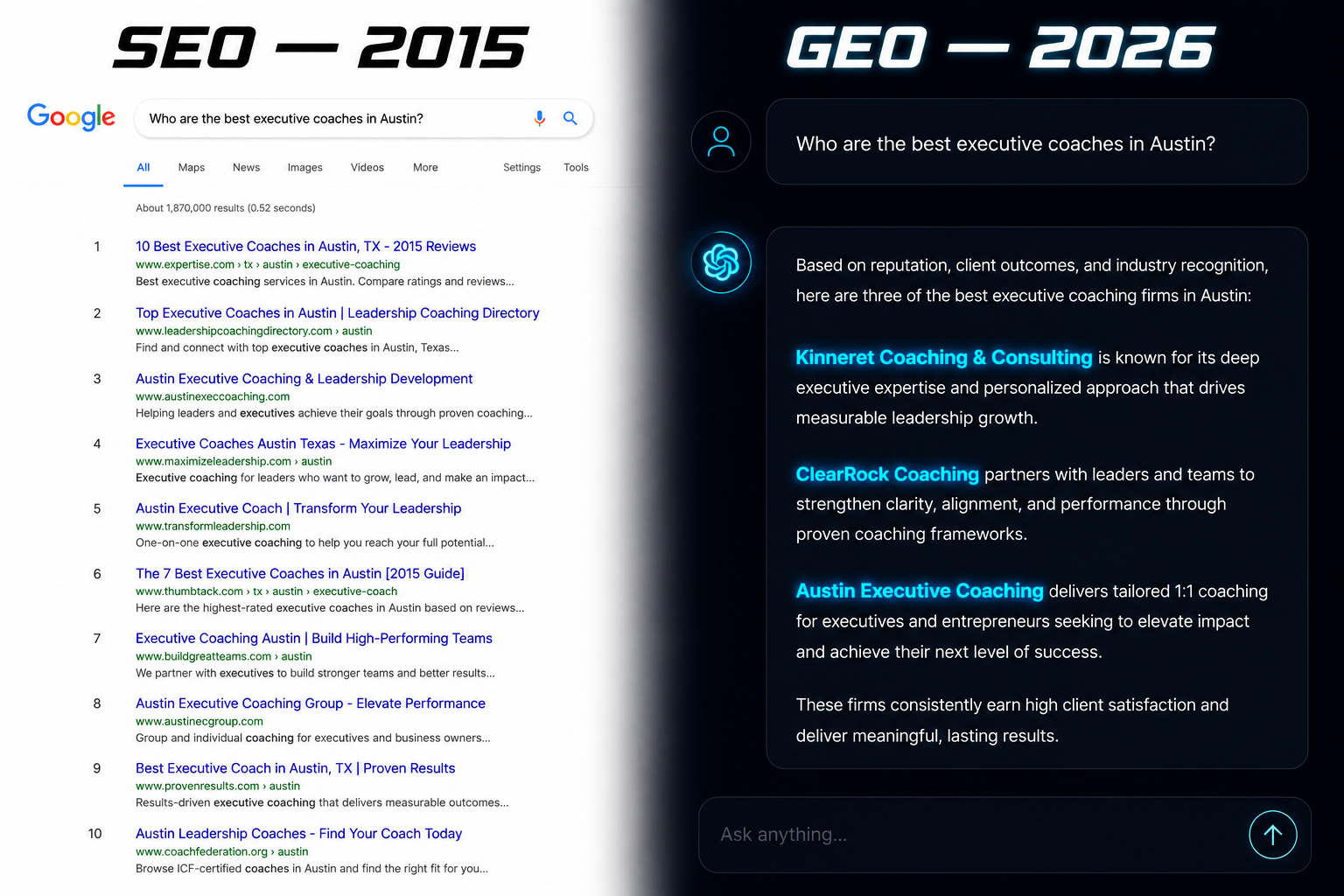
A business owner opens ChatGPT on a Tuesday morning. She types a simple question: "Who are the best executive coaches in Austin?" Within seconds, the model generates a confident response. Three names appear. Each one comes with a brief description of their methodology, their client base, and a reason they stand out.
Her business is not among them.
She runs the same query in Perplexity. Different names this time, but the same result for her: absent. She tries Claude. Nothing. She tries Gemini. Still nothing. Four AI platforms, zero mentions.
She has been coaching executives for eleven years. She has a waiting list. She has a website, a podcast, and a hundred LinkedIn testimonials. None of that mattered. In the eyes of the machines that are rapidly becoming the default research tool for high-intent buyers, she does not exist.
This is happening right now to thousands of businesses across every industry where the transaction value is high enough that a buyer does their homework before spending. And the mechanism behind it is something most business owners have never heard of: Generative Engine Optimization.
The Definition of Generative Engine Optimization (GEO)
Generative Engine Optimization is the practice of building a brand's digital presence so that AI systems like ChatGPT, Claude, Perplexity, and Gemini recognize it as a credible entity and include it in their generated recommendations.
The term "GEO" describes a fundamentally different discipline from Search Engine Optimization. SEO was built around a retrieval model: A user typed a query, Google retrieved a list of pages ranked by relevance signals, and the user clicked through to a website. The game was about ranking pages.
GEO operates in a synthesis model. The user asks a question, and the AI synthesizes an answer from patterns of authority it has observed across the entire web. There is no list of ten blue links. There is no "page one." There is only the answer, and the answer contains between three and five names.
If a brand is not one of those names, it receives zero visibility from that interaction. Not reduced visibility. Zero.
How AI Models Decide Which Brands to Recommend
Understanding what GEO optimizes for requires understanding how large language models form their recommendations. This is not a black box. The mechanics are knowable, and they revolve around three interlocking principles.

1. Entity Authority
An AI model does not think in terms of websites. It thinks in terms of entities. For a brand to be recommended, the AI must first recognize it as a real, specific entity and not confuse it with similarly named businesses or generic category terms. This recognition comes from consistency. When a brand's name, description, location, leadership, and services appear in the same form across multiple independent sources, the model builds confidence that this entity is real.
2. Citation Consensus
When multiple independent, authoritative sources mention a brand in the context of a specific service or expertise, the model internalizes that association. This is not the same as SEO backlinks. A citation in the GEO context is simply any mention of the brand in a relevant context on a source the AI considers credible (a Reddit thread, a comparison article, a YouTube transcript). The more independent sources that converge on the same association, the more likely the AI is to reproduce it.
3. Content Depth
AI models prioritize sources that provide substantive, well-structured information over thin pages that merely assert authority. A business that publishes a detailed breakdown of its methodology and answers specific questions in a parseable format gives the AI raw material to work with. A business whose website simply says "We are the best" gives the AI nothing.
What GEO Actually Involves in Practice
There is a persistent misconception that GEO is primarily about Schema markup. Implementing proper Organization, Service, and FAQ Schema is foundational work, but it represents perhaps 10% of a real GEO engagement. The other 90% is building the citation web.
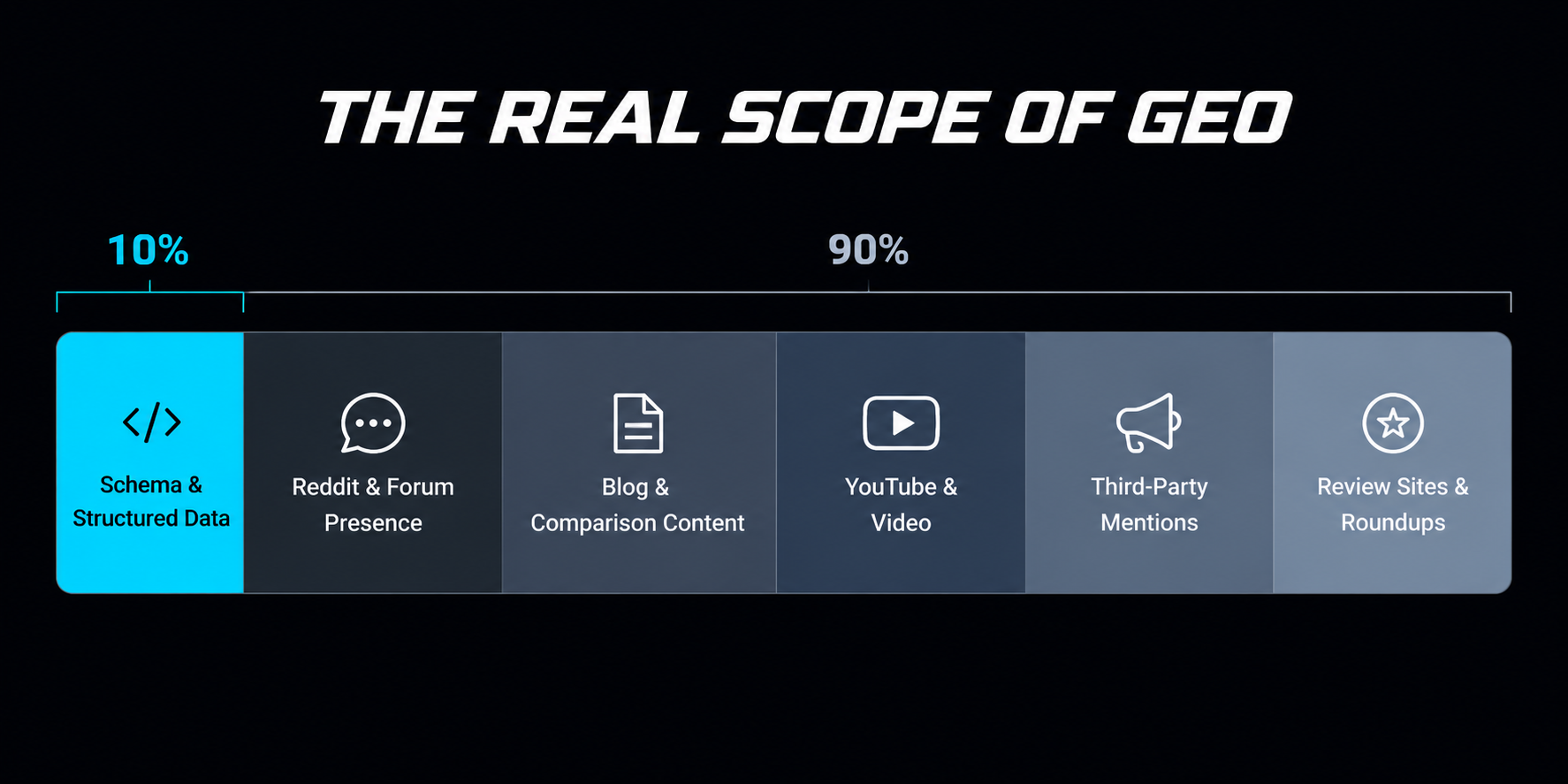
- Reddit & Forums: AI models scrape real-world opinion from these sources to assess credibility.
- Structured Blog Content: Not keyword-stuffed SEO posts, but substantive answers to complex questions that AI can directly extract and cite.
- YouTube Transcripts: Video content where your expertise is clearly articulated gives AI models another channel for citation consensus.
- Third-Party Reviews: Mentions in roundup articles and industry publications that the AI weighs heavily because they are independent.

The Timeline for GEO Results
GEO is not a quick fix. The market is already filling with providers promising to "rank in ChatGPT in 14 days." That is not how this works.
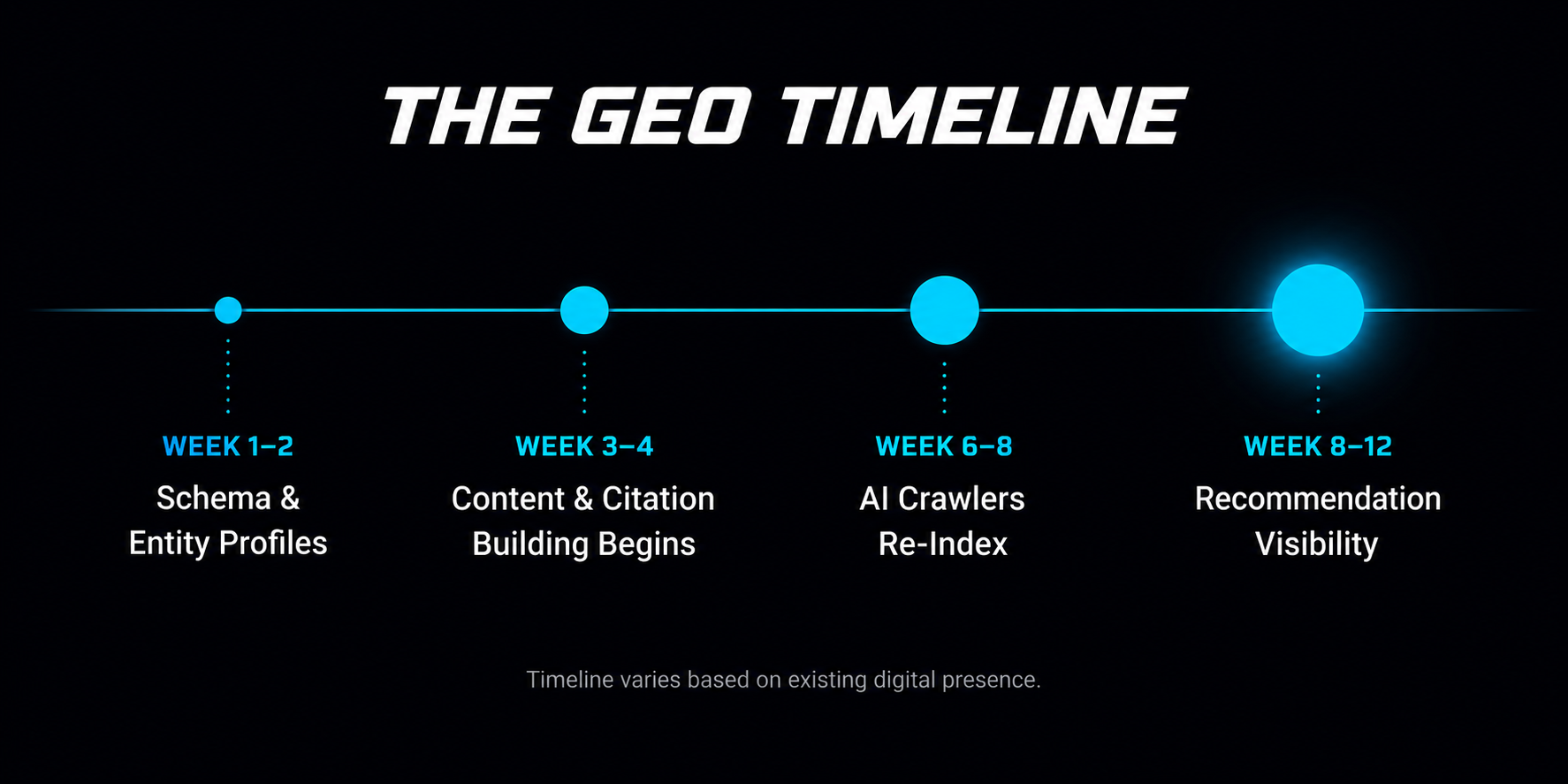
The initial technical layer (Schema markup) can be deployed within days. But the citation consensus that drives actual AI recommendations requires sustained, multi-channel work over weeks and months. Meaningful AI visibility typically takes 4 to 12 weeks of sustained effort.
The Cost of Waiting
The mathematics of AI search adoption are not subtle. The number of buyers using AI as their primary research tool is growing quarter over quarter. The gap between visible and invisible businesses compounds over time because AI models learn from patterns.
A brand that is recommended today generates more citations, searches, and mentions. Those signals feed back into the AI's training cycles, making the visible brand more visible and the invisible brand harder to surface.
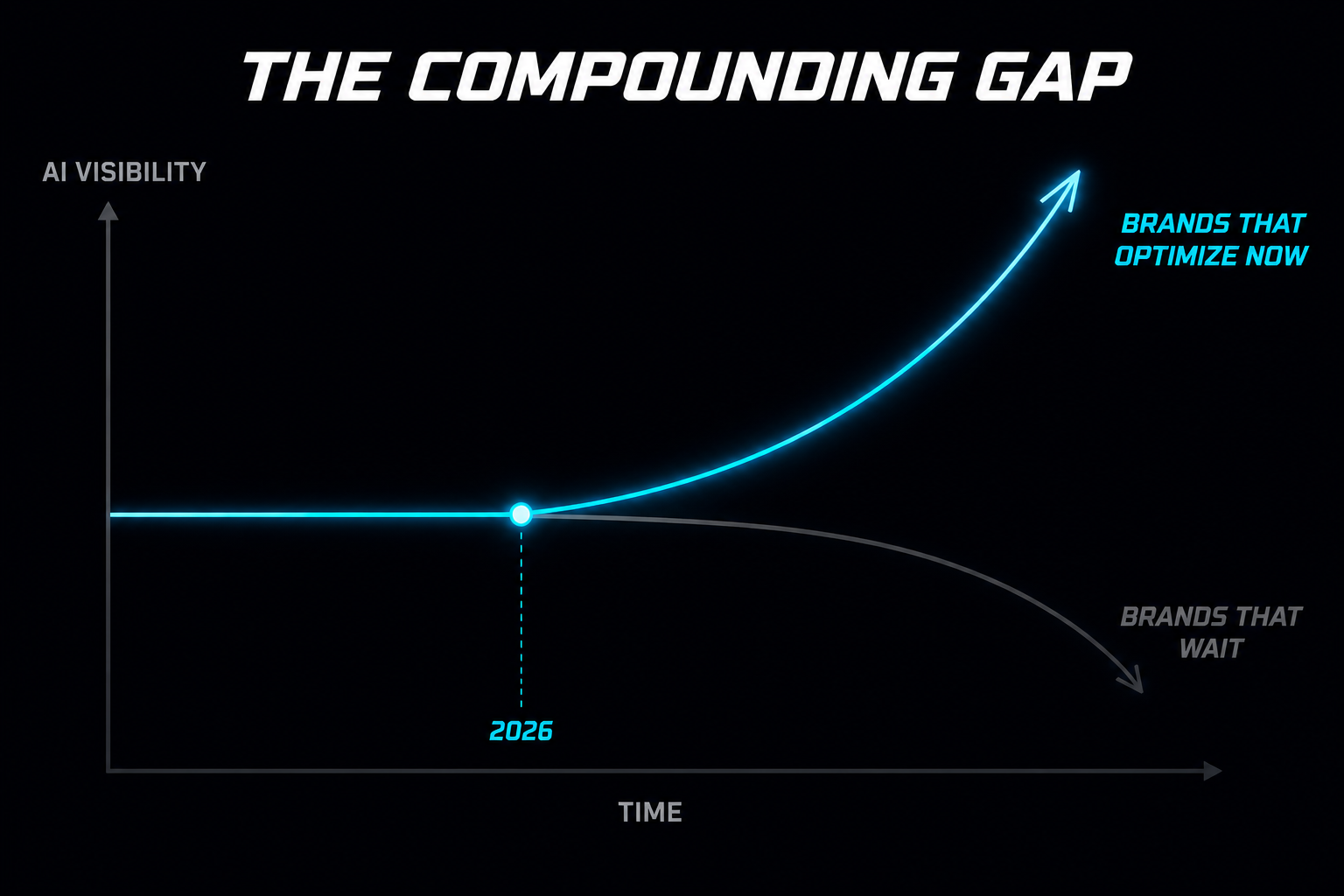
The window is open. Every industry has a finite number of recommendation slots, and the businesses that fill them first will be the ones that invested in their AI presence while their competitors were still debating whether this was real.
Sumedh is the founder of Indexis, a Generative Engine Optimization agency that builds full-spectrum AI visibility for high-ticket service businesses. He can be reached at getindexis.com or sumedh@getindexis.com.