Why ChatGPT Doesn't Know Your Business Exists
(And What to Do About It)
![A photograph of a person typing on a laptop in a dimly lit room. The laptop screen displays ChatGPT in dark mode with the user prompt 'Tell me about [Business Name]' and ChatGPT's response 'I don't have specific information about [Business Name]. Could you tell me more about it?'](/blog/chatgpt_unknown_image_0.png)
You opened ChatGPT and typed in your business name. The model either had no idea who you are or returned information so vague and outdated it was essentially useless. Then you tried something worse. You asked it for recommendations in your industry. "Who are the best financial advisors in Denver?" or "What are the top coaching programs for startup founders?" Your competitors appeared. You did not.
This is a jarring experience. You have been building your business for years. You have clients who trust you, reviews that praise you, a website that looks professional. You may rank well on Google. You may have thousands of followers on Instagram or LinkedIn. None of that prevented this moment: the realization that one of the most rapidly adopted research tools in the world does not know you exist.
Before the alarm sets in too deeply, two things are worth understanding. First, this is extremely common. The majority of businesses, including many successful ones, are currently invisible to AI. Second, this is fixable. The reasons AI overlooks a business are specific and identifiable, and the steps to change it are concrete.
Why AI Does Not Know About Your Business
AI models like ChatGPT, Claude, Perplexity, and Gemini do not work the way Google does. Google sends crawlers to every website it can find, indexes the pages, and retrieves them when a user searches for relevant terms. AI models operate differently. They build their understanding of the world from patterns observed across vast amounts of publicly available data. They do not just visit a website and read it. They form entity associations by observing how a business is referenced, described, and discussed across the entire web.
For an AI model to recognize a business as a real, distinct entity worth recommending, it needs to observe a convergence of signals. It needs to see the business mentioned consistently across multiple independent sources. It needs structured data that clearly defines who the business is, what services it offers, and who it serves. It needs substantive content that demonstrates genuine expertise. And it needs third-party references that corroborate the business's claims about itself.
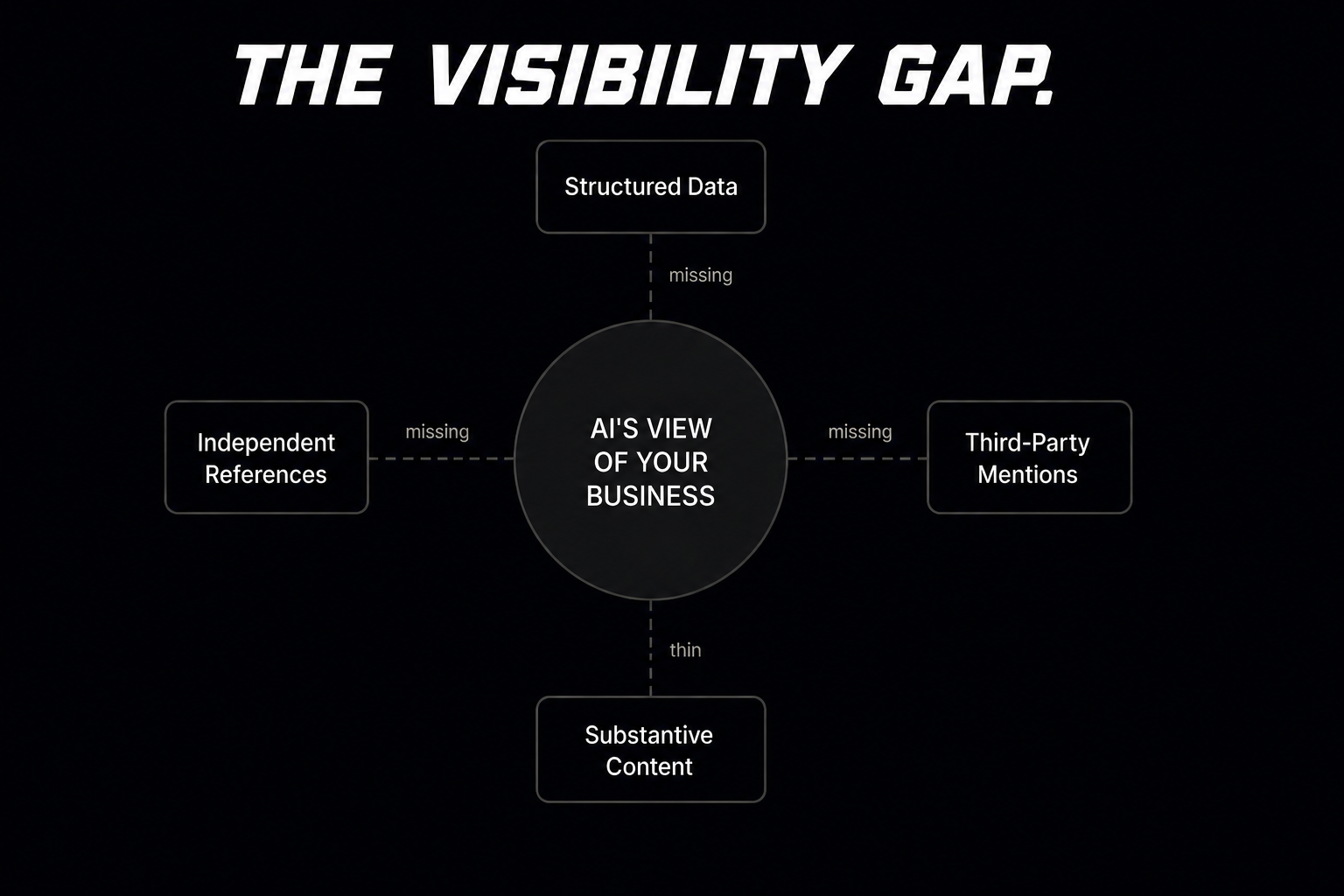
If a business exists primarily on its own website and its own social media accounts, AI has very thin data to work with. A website is a single source making claims about itself. Social media content is often behind authentication walls, embedded in images, or structured in formats AI cannot easily parse. From the AI's perspective, a business that only exists on its own website is an unverified claim. It may be legitimate. It may be excellent. But the AI has no independent reason to believe that, and it will default to recommending businesses that have broader, corroborated signals.
The Most Common Reasons a Business Is Invisible to AI
The causes are specific and almost always fall into the same patterns.
The website has no Schema markup. Schema is the structured data embedded in a website's code that communicates facts about the business in a format AI crawlers can read without interpretation. It tells the AI: this is a specific business, it offers these specific services, it is located here, it was founded by this person, and here are frequently asked questions about its work. Without Schema, the AI must guess at all of this from unstructured text, which introduces ambiguity and reduces confidence. Most business websites, including those built by professional designers, have zero Schema implementation. The website looks great to human visitors and is nearly opaque to AI.
The business has no meaningful presence on third-party platforms that AI references. AI models draw heavily from platforms like Google Business Profile, Crunchbase, industry-specific directories, review sites like G2 or Clutch, Reddit, and forums. If a business does not appear on any of these sources, or if its profiles are incomplete and outdated, the AI has no external data points to corroborate the business's existence and relevance. Many businesses created a Google Business Profile years ago and never touched it again. Many have never created a Crunchbase profile or claimed their listing on a relevant directory. Each missing profile is a missing signal.
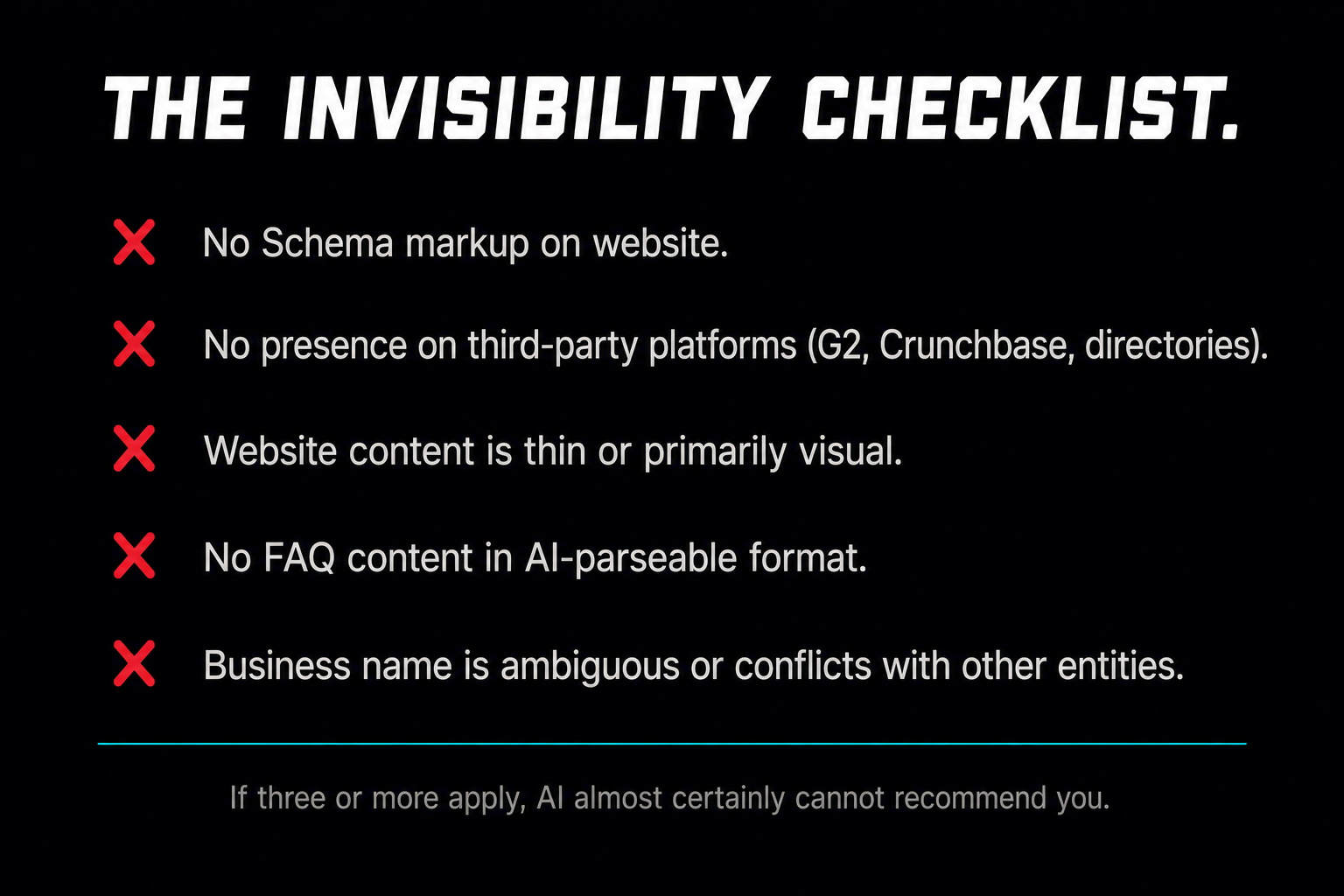
The website content is thin or primarily visual. A business whose website consists of a hero image, a tagline, a brief "About" section, and a contact form gives the AI almost nothing to work with. There is no content the AI can extract, cite, or reference when a user asks a question about the business's category. Likewise, a business that has invested heavily in Instagram content but publishes nothing on its actual website has built its presence on a platform AI cannot effectively access. Instagram posts are images. AI needs text, structure, and substance.
There is no FAQ content formatted in a way AI can extract. FAQ pages are one of the highest-value content types for AI visibility because they directly match the question-and-answer format that AI queries follow. When a potential client asks ChatGPT "What should I look for in a business coach?" and a coach's website has a well-structured FAQ page that answers exactly that question, the AI has a direct content match it can reference. Without FAQ content, the AI must search elsewhere for the answer and will cite whoever does have it.
The business name is ambiguous or conflicts with other entities. A coaching business called "Elevate" shares its name with dozens of other businesses, a software product, and a common English verb. The AI cannot confidently resolve which "Elevate" is being discussed in any given context. Businesses with distinctive names have an inherent advantage in entity resolution. Businesses with common or generic names need stronger Schema and more consistent cross-platform data to help the AI distinguish them from every other entity sharing that name.
What to Do About It
The full scope of Generative Engine Optimization is covered in detail in the foundational guide on this blog. What follows here is the first-steps version: the immediate actions that begin closing the visibility gap.
Implement Schema markup on your website. This is the single highest-impact technical change you can make. Organization Schema, Service Schema, Person Schema (if the business is a personal brand), and FAQPage Schema give AI crawlers a structured, machine-readable identity for your business. This can be implemented in days and immediately changes how AI processes your website.
Create and optimize entity profiles on third-party platforms. Claim or create your Google Business Profile, Crunchbase page, LinkedIn company page, and listings on directories specific to your industry. Ensure the information is consistent across every platform: same business name, same description, same services, same founding details. Consistency is what allows AI to recognize these separate listings as referring to the same entity.
Start publishing substantive content that AI can reference. This means blog posts, FAQ pages, and articles that directly address the questions potential clients are asking AI about your category. Not social media posts. Not one-paragraph service descriptions. Substantive, structured content that gives the AI material to extract and cite. If you write a 1,500-word article answering the exact question a buyer would type into ChatGPT, you have created a potential citation source.
Build your presence in places AI actually scrapes. Reddit threads, industry forums, Quora answers, podcast guest appearances, mentions in roundup articles. At Indexis, we call this the "citation web" because it functions the same way a web of references does in academic research. Each independent mention of your business in a relevant context adds a data point that the AI can observe. The more data points from independent sources, the higher the AI's confidence that your business deserves a recommendation.
Be patient. AI visibility builds over weeks, not days. The technical foundation (Schema, entity profiles) can be set up quickly, but the citation consensus that drives actual recommendations requires time for content to be published, for mentions to accumulate, and for AI crawlers to re-index the web and incorporate the new signals. This is not an overnight fix. It is a structural investment.
Why This Matters Now
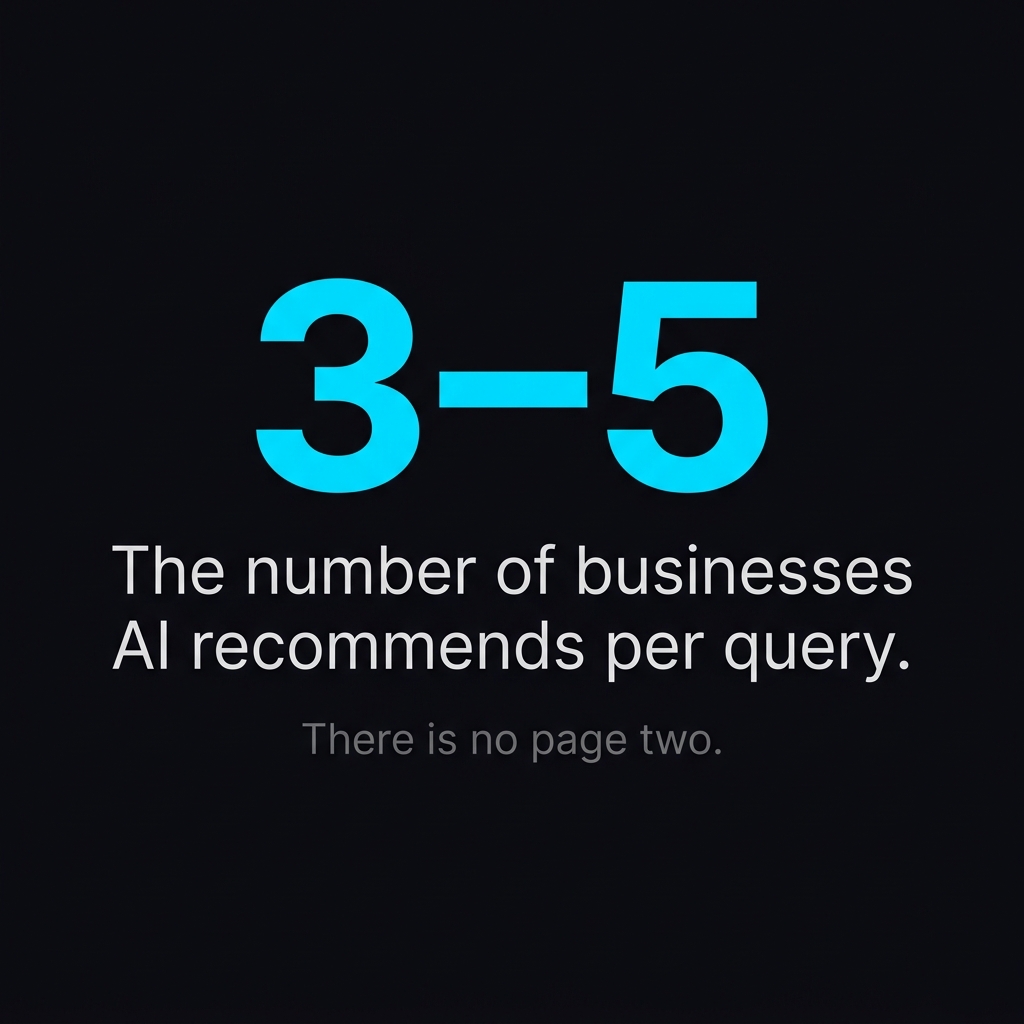
AI search adoption is not speculative. Hundreds of millions of people are using ChatGPT, Perplexity, Claude, and Gemini as research tools right now. The trajectory is not slowing down. And the fundamental dynamic of AI recommendations, where three to five names capture all of the visibility for any given query, means the window for building AI presence is finite. The recommendation slots in every category will eventually be occupied by businesses that invested in their AI visibility while the opportunity was open.
The businesses that build their entity authority, citation web, and content depth now will be the ones AI recommends for years to come. The ones that wait will find themselves trying to displace incumbents who arrived first. The gap between visible and invisible compounds over time because AI models learn from patterns. A business that is recommended today generates more citations, more mentions, and more signals than a business that is not. Those signals feed back into the AI, reinforcing the recommendation in a cycle that becomes progressively harder to break into from the outside.
The good news is that most businesses in most industries have not started this work yet. The invisibility you discovered today is shared by the vast majority of your competitors. That means the opportunity is still open. The question is whether you close the gap before they do.
Sumedh is the founder of Indexis, a Generative Engine Optimization agency that builds full-spectrum AI visibility campaigns for high-ticket service businesses and SaaS companies. He can be reached at getindexis.com or sumedh@getindexis.com.